THE MINER AND THE FIRST WORLD WAR 1914-1918.
By Eileen Paddock and Joyce Wilson.
When War was declared against Germany on August the 4th 1914 the Army needed more soldiers, so an appeal was made for volunteers. Thousands of men rushed forward to sign for King and Country, and included in these volunteers were a great many miners from the North Staffs area. The Army were very pleased to welcome the miners to their ranks as these were tough hard working men used to working as a team and looking after their mates every day in the bowels of the earth.
Who were these men who readily put themselves forward? It is difficult to find out as I can testify to.
After a lot of thought I decided to write a letter to the local daily newspaper, "The Sentinel", asking if any relatives of these long lost miners had any family stories to tell that had been handed down through the family.
I had a lot of telephone calls and a few letters. The people that I have spoken to have been very helpful and are very proud of their fathers and grandfathers, and so should we all be when we consider what they went through for us.
Not all miners were in the Army. A lot stayed in this country still working in the mines. Coal was a vital commodity, the country could not have survived without it. Coal was needed for industry, shipping, railways and we must not forget the housewife who needed it to heat the water to bath the miner in the tin bath when he arrived home in all his pit dirt, after he had eaten his meal that had been cooked on the coal fire.
Here are the stories that have been told to me...
(N.B. with additional contributions from J. Wilson)
E. Paddock
Select a story...
CHARLES HENRY NEWBON
KINGS ROYAL RIFLE CORPS 7TH BN
Killed in action Friday 22nd December 1917, aged 27, son of James and Hannah Newbon, 60 Wise Street Dresden. This is the letter that was published in the Weekly Sentinel Newspaper January 1918.
Mrs Newbon 60 Wise Street Dresden has received official news that her son Rifleman C H Newbon Kings Royal Rifles has been killed in action He had previously been wounded. Prior to enlistment in October 1914 Rifleman Newbon who was 27 years of age was employed at the Florence Colliery. His Captain has written to Mrs Newbon saying; at the time he was acting as my servant and we were going up to the trenches when a shell fell very near to us and your son was killed instantly. I have known him for over a year now and he was one of the best men and soldiers in the Battalion. It is all the sadder as he would have been going home on leave about this time had he lived. Mr MacGregor to whom he was previously servant will be very much grieved I am sure when he learns of your sons death. All the officers and men are very sorry to lose him.
Charles Henry Newbon is commemorated on the Tyne Cot Memorial. Dresden Church Memorial and Longton Cenotaph. He was awarded a 1914-15 Star Silver War Medal and a Victory Medal.
E. Paddock
SAPPER GEORGE RILEY
ROYAL ENGINEERS.
Killed in action 1st September 1915. 89 Caroline Street Longton.
Employed by Stirrup and Pye Adderly Green. Also fought in the Boer War.
His next door neighbour is given below
PTE HUGH COLLIN ROSON
NORTH STAFFS REG.7th BN.
Killed in action Gallipoli 17th August 1915.
91 Caroline Street Longton. Enlisted 1914.
Employed by Stirrup and Pye Adderly Green.
These two men were not only neighbours but also they obviously worked together at Stirrup and Pye which was a local coal mine.
E. Paddock
PRIVATE JOHN PADDOCK 1st/7th BN.
NORTH STAFFORDSHIRE REGIMENT.
Age 35 Died 23rd August 1915 He is buried at the East Mudros Military Cemetery Island of Lemnos Greece. Private John Paddock was the grandfather of my husband Arthur. John was at Gallipoli but he was not killed there. He was taken ill with dysentery, as were hundreds more, and he died in hospital after being shipped back to Egypt. The family did not know much about him or his background before 1912 as he arrived in Stoke-on-Trent that year from Shrewsbury. All that we ever knew was that he had been a butcher. When he arrived in Stoke-on-Trent he went to work at the local pit, which one we do not know. We do know that he worked as a coal miner roadman and he lived at Smallthorne. In 1913 he was a coal hewers loader and lived at Milton. What a difference, outdoor butcher to underground miner. It must have been horrendous for him and I wonder if that was one of the reasons that he volunteered for the Army. In 2001 I was researching the Paddock family tree when to my amazement I discovered the Shrewsbury part of the family, but that is another story.
One day as I was talking to my mother-in-law about this project that I was researching she said that her mother had two brothers killed in the First World War and that they had been miners. They had both worked at Chatterley Whitfield Colliery. I sent a letter to the Commonwealth War Graves Commission asking for their details and this is the reply.
E. Paddock
PRIVATE EDWIN TURNER.
"B" COY.1ST/5TH Bn NORTH STAFFORDSHIRE REGIMENT.
He died on Saturday the 4th February 1917 age 20. He was the son of Samuel and Mary Turner of The Rocks Bank End Brown Edge. He is buried at Warlincourt Halte British Cemetery, Saulty
RIFLEMAN A TURNER
RIFLE BRIGADE
He died on the 28th August 1918 and he is buried Hem Farm Military Cemetery , Hem- Monacu.
There are some stone memorial tablets set into a seat outside the village hall at Brown Edge, they commemorate all the men killed from the village in the First World War. The stones were found in the old school and had been made by the school children. Most of the names on them would be miners, included are the two Turner brothers. In the book A Brown Edge History, Alan Pointon,( Edited and compiled by Elizabeth Lawton,) there are photographs of some of the soldiers whose names would be on the memorial.(p60-71)
E. Paddock
W.A.BOWERS AND THE MEN OF PARK HALL COLLIERY.
W.A.Bowers lived at Caverswall Castle with his wife and daughter. He was the owner of Park Hall Colliery. Ltd. Cheadle Staffs. He became the owner in 1911 at the age of thirty when William Eli Bowers his father died. 31 men from the colliery enlisted into the Army, four gave their lives for their country including W.A.Bowers. A memorial was erected to their memory in 1919 at the colliery but when the colliery closed it was moved, and it now stands at the entrance to an industrial estate built on the site of the colliery. In April 2002 the memorial was in need of some renovation work- the iron railings needed replacing. Placed on the memorial was a wreath of red poppies, so it would seem that they are not forgotten. To find this memorial you take the A52 from Bucknall, Stoke-on-Trent, to Cellahead across the traffic lights to the top of the hill, turn right into the road signposted Dilhorne, Proceed approx. 1 1/2 miles, the colliery is on the right and the memorial is situated at the second entrance which is now occupied by Ferguson and Wild. The names on the memorial are:-
Lieut W.A.Bowers of the North Staffs Regt. Dide of wounds 2nd July 1916.
Pte C.A.Hughes of the East Lancs Regt. Died in action 1st August 1918
Pte K.Lovatt of the Northumberland Fusiliers. Dies in Germany 5th Dec 1918
Pte L.E.Nutt of the Suffolk Regt. Killed in action 2nd Oct 1918
E. Paddock
LANCE CORPORAL WILLIAM DAVENPORT
8TH NORTH STAFFS REGT.
In reply to my letter in the local newspaper the "Sentinel" dated May 18th 2002 I received this letter from Mrs L.A.Dawson. It makes very interesting reading so I am going to record it just as it was written.
Dear Eileen,
In reply to your request in Saturdays Sentinel. My Grandfather was a collier (Jigger) that was in 1913 on my mothers birth certificate, I do not know which pit he worked at. He joined up (enlisted) at Burslem on the 31st of August 1914 he lived in Sant St. Burslem with his wife Elizabeth and son Sydney daughter Edith and later daughter Mary.
My Great Grandmother was born in Sant St. as was my father and mother.
15725 LANCE CORPORAL WILLIAM DAVENPORT
8 BN NORTH STAFFORDSHIRE REGT.
ARRIVED IN FRANCE 25-8-1915.
KILLED IN ACTION 19-11-1916
BURIED CONNAUGH CEMETERY THIEPVAL SOMME FRANCE.
Three years ago this month (June19?) I found my Grandfathers grave and read a verse that my Great Grandmother had put into the Evening Sentinel (local newspaper)
Sleep on dear son, In a far off grave, A grave we may never see, As long as life and memory last, We will remember thee.
This is one of many memorials she placed over the years. My mother could not remember her father and thought his name was Henry but that was her step father who was also killed in the First World War. Both their names W. Davenport and H. Kirkham are on the memorial plaque in St. Johns Church Burslem. My grandmother Lizzie went on to marry twice more and had eleven children. I have no photograph of my grandfather but I have his Soldiers Small Book which states, 5feet 7inches, Fresh Complexion, Grey eyes, Light Brown Hair, Scar over nose, Small one over right eyebrow.
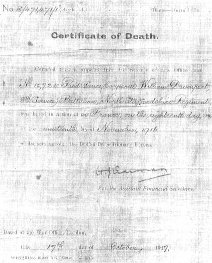
I also have his death certificate, a letter from the War Office and one from the Record Office, all these I can photocopy for you, but as I said I do not know which pit he worked at. I have lots of other literature on where he died and the battle he died in which was for the River Ancre. The (Royal) British Legion have placed a wreath on the grave in France as through ill health I have not been able to go myself.
Yours,
L.A.Dawson.
About a week after speaking to Mrs Dawson on the telephone I received a large brown envelope through the post, it contained copies of the documents that she had promised me. These included a letter dated the 18th Sept 1917 confirming that he had been killed in action on the 18th or 19th Nov 1916. He had previously been reported missing and so for ten months his family had no idea what had happened to him.Although it must have been a dreadful shock to his wife. At least she finally knew what had happened to him and that he would have a proper grave.
The next document that I saw was his death certificate stating his number rank and name and killed in action in France. Although Mrs Lillia Dawson never knew her grandfather she has a great deal of affection for him and is passing this on to her granddaughter Sarah who was twelve when she wrote this poem for him.
FAR AWAY IN THIEPUAL FRANCE MY GREAT GREAT GRANDAD LIES,
HE DIED FOR HIS COUNTRY, HE DIED TO SAVE US,
HE WAS BRAVE, FEARLESS AND COURAGEOUS.
HE LEFT HIS FAMILY, FRIENDS AND COUNTRY
SO WE COULD LIVE IN PEACE.
E. Paddock
CHARLES CLEWLOW
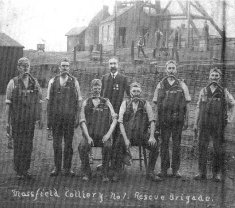
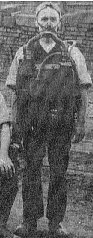
On the 4th of June 2002 I had a telephone call from a Mr. Alan Clewlow, he said that he had two photographs of his father taken wearing all the equipment of the Mossfield Colliery Mine Rescue Brigade and would I like to see them. I made an appointment to interview him and this is the story he had to tell.
His father Charles Clewlow had been born in either 1878 or 1879 at Cheadle, and he started to work in the pit when he was thirteen.
He married a young woman named Ellen Pegg and before the First World War they had four children.
He attended Technical school and on the 25th of September 1897 he was admitted a member of the Midlands Miners Federation.
His job at the colliery was a fireman.
He was thirty-six years of age when he volunteered for the Army in 1914, his Regiment was the Kings Royal Rifles.
He was wounded in 1916 and confined to a wheelchair for a number of years, nevertheless he recovered and started back to work at Mossfield Colliery.
His wife had a further five children, Alan was next to the youngest child.
E. Paddock
JOSIAH MELLOR
Not all miners of course either volunteered or were conscripted into the Army, as I have said previously they were needed here to work in the mines, one of these men was a Mr Josiah Mellor. In an interview that I had with his son William in June 2002 (who by the way was aged 92 years of age at the time) these were his memories and stories of his father.
Josiah Mellor was born at Sneyd Green Staffs in the year 1888. He went to school at Sneyd Green and he left school at the age of thirteen and went to work at the Racecourse Colliery at Cobridge, this was part of the Grange colliery. He attended night school at Hanley and passed all his certificates until eventually he became Under Manager at the Racecourse Colliery (his younger brother became Over Manager).
He had quite a few accidents and while recovering in the North Staffs Royal Infirmary Hospital he met his wife to be, she was a Miss Lydia Jones and her parents lived at Pear Tree Cottage Trentham Rd. Trentham. William said "we never went short of anything during the First World War as my father was still at the pit and my mother kept a general grocery shop at Sneyd Green"
Josiah worked until the age of fifty two when he had to leave his job because he had developed a condition of the eyes called Nystagmus,this is a common condition in miners, it causes blindness. I asked William if his father had been given any compensation and yes he had, it was the princely sum of �75. Mr. Josiah Mellor died at the age of seventy- six.
E. Paddock
JOHN HAROLD RHODES
John was born in Mellor Street, Packmoor, Staffs, on 17th May 1891, the son of an ex-soldier
Ernest Rhodes. He went to school in Newchapel. After leaving school worked as a miner.
About 1910 he joined the Grenadier Guards and served for three years. He returned to the
Potteries to work at Chatterley Whitfield Colliery.
On the outbreak of the First World War in 1914, John was recalled to the forces as a reservist.
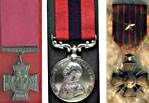
He won the Distinguished Conduct Medal on 17th May 1915 and three months later was awarded a bar
to this medal.
He returned to England to recover from his wounds and in 1915 married Elizabeth Meir of
Pittshill. There was only one child from this union who was named after his father, but sadly
John did not live to see his son.
He returned to the front and on the 9th October 1917 he was awarded the Victoria Cross and
the Croix De Guerre for storming an enemy pillbox and capturing nine prisoners single-handed.
Later in the war, he was wounded and subsequently died of his injuries.
Memorial services were held in Newchapel parish church in 16th December 1917, in Packmoor
Primitive Methodist Chapel on 30th December 1917.
A memorial plaque was unveiled at Chatterley Whitfield Mining Museum on 20th April 1984.
J. Wilson
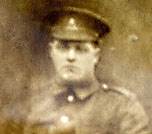
GEORGE PHILIPS
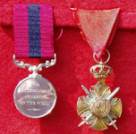
Distinguised Conduct Medal, Serbian Cross of Karageorge
To the miners of the Chatterley Whitfield June the 28th 1914 was much the same as any
other Sunday. Families will have either been to church or chapel or would go before the day
was out. Some of them would be fishing or swimming in the local ponds, others would be walking
in the surrounding lanes and fields.
Many men would be in the pubs while their wives, or mothers prepared the Sunday
dinner. Children would be playing hopscotch or with their shotties in the streets. No one in
this small bustling village, which was dominated by the colliery could possibly know that on
a busy street in a far away land events were taking place that would profoundly affect all of
their lives.
On this fateful day, while on an official visit to Sarajevo the capital city of the
Austrian province of Bosnia. Archduke Franz Ferdinand, heir to the Habsburg throne and his
wife Sophie, were attacked and killed by members of the Slav nationalists group The Black
Hand Society. One of the Societies members, a student by the name of Gavrilo Princip fired
three shots at close range into the royal car. Fifteen minutes later the Duke and his wife
were dead. These three shots started a series of events that would culminate in the death
of millions in The First World War.
The people of Britain answered the government?s call to support the surpressed of Europe.
It was especially important that Mineworkers produced as much coal as possible to help the
war effort. However, some miners responded differently and went to war. George Phillips a
miner from Chatterley Whitfield who lived in Smallthorne, decided to do his bit by enlisting
in the North Staffordshire Regiment.
The Staffordshire Weekly Sentinel of the June 9th 1917 reported that George had been
awarded the Distinguished Conduct Medal and the Serbian Cross of Karageorge (black George).
This medal was introduced in 1915 for acts of conspicuous bravery by Non Comissioned Officers
and soldiers in the field.
At a ceremony in Derby, General Sir John Maxwell made the presentation to George. The
official Record said, "he bombed the enemy continuously for 31 hours, later he deliberately
bombed the enemy from the open to draw off the enemy's attention from another regiment. In
doing so he showed great gallantry and determination".
We would like to put on record our appreciation to George Phillips Junior who contacted us
by email and sent us photographs of his father and his fathers medals. He stated "I was
tremendously excited when I found your web site. I was aware of the citation for his DCM but
to think that someone had taken the trouble to publish it was really something".
Well George, we can assure you it was an honour and a privilege for us to use this web site
to ensure your father's bravery was not forgotten.
J. Wilson
In Stoke-on-Trent and the surrounding districts thousands of miners lived and worked at the outbreak of the so called War to end all Wars (1914-1918) and these are the stories of only a very few of them. I hope that you have found them to be interesting, if so and you have stories of your own grandfathers and great grandfathers please write them down before it is to late and they all become forgotten,please do not think that they will not be interesting to other people, they will be.
If you would like to tell me about them I can be contacted atEmail:- eileenpaddock@tiscali.co.uk
E. Paddock
For more on World War One Miners Click Here